Picture a phone buzzing on the coffee table. A name lights up the screen, a message that is warm, a little too personal, from someone who is not you. Is it nothing? Is it something? You feel the question land in your stomach before your mind can answer it.
Most people who go looking for the meaning of “micro-cheating” are standing in one of two places. Either they are trying to work out whether their partner has crossed a line, or they are quietly trying to work out whether they themselves have. Those are very different conversations, and a good guide should serve both. There is also a third reader who deserves attention: the person who cannot stop worrying and is no longer sure whether the problem is their partner or their own anxiety.
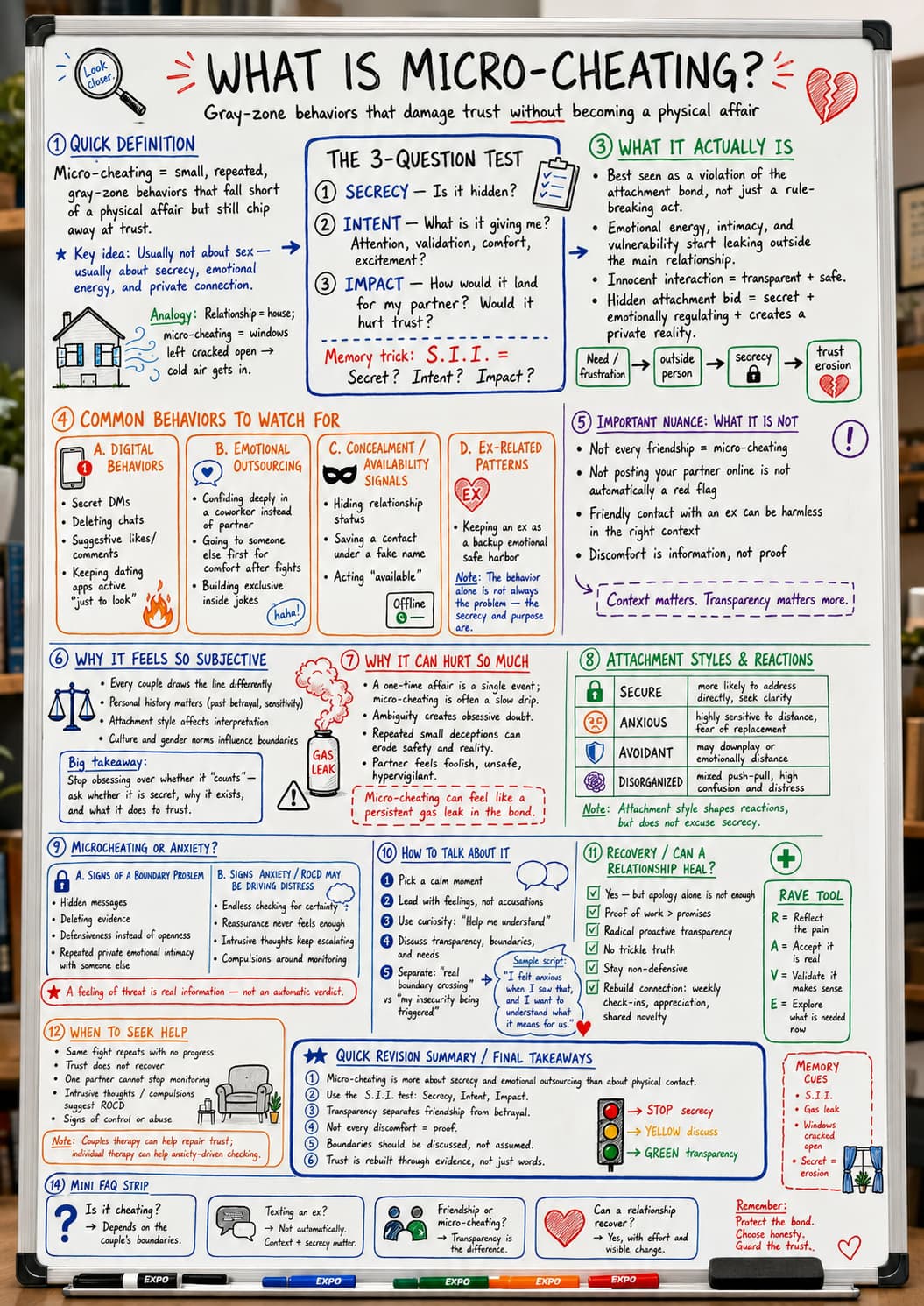
Here is the practical answer first, so no one leaves empty handed. Micro-cheating refers to small, repeated, gray-zone behaviors that fall short of a physical affair but still chip away at a relationship. None of them are sex. What they tend to share is secrecy: the part you would not want your partner to see in full. As couples therapist Figs O’Sullivan puts it, the most useful question is rarely “does this count?” The better question, the one that points at the real work, is what this outside connection is giving you that you are not getting, or not asking for, at home.
A simple image holds the whole idea together. If your relationship is a house, micro-cheating behaviors are windows left cracked open. Not wide enough for anyone to climb through, but enough to let the cold air in. Leave them long enough and the whole house goes chilly.
What Micro-Cheating Actually Is
It is tempting to treat micro-cheating as a checklist of forbidden acts, but the most clarifying definitions move away from the act itself. From a clinical, attachment-based perspective, micro-cheating is not defined by whether physical contact happened. It is defined by a violation of the attachment bond between two committed partners.
The reasoning goes like this. Human beings are wired for connection, and inside a committed relationship the nervous system runs a kind of quiet background scan, asking two questions over and over: are you there for me, and am I enough for you? When you commit to someone, you implicitly agree to be each other’s primary safe harbor. Micro-cheating, in this view, is the slow and repeated outsourcing of those attachment needs to someone else. Emotional energy, intimacy, and vulnerability begin to leak away from the main bond and toward an outside source.
That gives us the cleanest practical test there is, one O’Sullivan draws in his own practice: the difference between an innocent interaction and a hidden attachment bid. An innocent interaction is fully transparent and does not trip your partner’s internal alarm. A hidden bid is laced with secrecy and quietly regulates your own emotions outside the relationship. You are building a private reality, even if you never meet the other person face to face.
This maps neatly onto the three signals most relationship experts agree on: secrecy, intent, and impact. Is the behavior hidden? What is it for? And how does it land for the partner who senses it? If you can hold those three questions, you rarely need a rulebook.
One nuance worth planting early, because it matters later: discomfort by itself does not prove a boundary was crossed. A feeling of threat is information, not a verdict. We will come back to that.
The Behaviors to Watch For
In his clinical work, O’Sullivan watches for a recognizable set of behaviors that read less like harmless quirks and more like an outsourced attachment bid. Paraphrased, they include texting an ex often enough to keep a backup safe harbor on reserve; hiding or deleting conversations, where the secrecy is itself the wound; confiding your deepest frustrations in a coworker rather than your partner; suggestively liking or commenting on specific people’s posts, a kind of simulated pursuit; keeping dating profiles active “just to look”; saving a contact under a fake name; building exclusive inside jokes that wall a partner out; downplaying your relationship status so you read as available; and turning to a third party for comfort during a fight instead of toward your partner.
It helps to think of these in clusters rather than as a flat list. There are digital behaviors, such as the secret DMs and the strategic likes. There are real-world and verbal ones, such as intense flirting that never quite acts on itself, or sharing intimate details that belong inside the relationship. There are behaviors that conceal the relationship itself, such as slipping off a wedding ring or never appearing in a partner’s life online. There are ex-related patterns. And there are conflict-driven ones, where comfort gets sourced from outside the moment things get hard.
If you are checking yourself rather than a partner, here is a more honest tell than any single act: notice where your energy goes. The small thrill when one particular person’s notification appears says more than the content of the message ever will.
A caveat belongs right here, because a list like this can quickly become a paranoia generator. Several of these behaviors are completely benign for many couples. Staying in friendly contact with an ex you co-parent with is not a betrayal. Not posting a partner who values their privacy is not a red flag. The signal was never the surface behavior. It was the secrecy and the intent behind it.
Why It Is So Subjective, and Why That Is the Point
There is no fixed definition of micro-cheating because, in practice, every couple writes its own. One pair treats playful banter as harmless. Another experiences the same banter as a small betrayal. The line moves depending on personal history, since people who have been cheated on before tend to be more sensitive to it. It moves with attachment style, which we will get to. And it moves with cultural and gender norms, since different communities hold very different ideas about acceptable closeness with people outside a relationship.
Research adds a wrinkle worth handling carefully rather than as a rule: studies suggest women may be more emotionally affected by online micro-cheating behaviors, and may feel more jealousy after discovering them, than men. That is a pattern in the data, not a law about any individual couple.
All of this lands in the same place, just by a different road. If the definition itself is movable, then arguing about whether something technically “counts” is mostly a way to avoid the harder conversation. The questions that actually move things forward are simpler. Is it secret? What is it giving me? Would it hurt my partner to find out?
Why Micro-Cheating Can Be Worse Than a One-Time Affair
Here is the part that surprises people. We tend to assume a single act of physical infidelity is the worst thing that can happen to a relationship. O’Sullivan makes the counterintuitive case that the slow drip of micro-cheating can damage the bond more deeply over time.
A discovered affair, devastating as it is, tends to be legible. There is an event, a timeline, a story that makes painful sense. Micro-cheating is more like a persistent gas leak. It is a long pattern of small deceptions, hidden messages, denied flirtations, and minimized closeness, none of which ever quite resolves into a clear narrative.
The deepest injury is not any single behavior. It is what happens when the partner who senses something raises it and is told, again and again, that they are crazy, jealous, or controlling. Over months or years, that does something corrosive: it erodes a person’s confidence in their own perception of reality. By the time the full picture comes into the light, the partner who sensed it has often spent a long time being quietly invalidated, their body stuck in a state of chronic alertness, their nervous system told there is no threat while it keeps insisting there is. Then comes the exhausting work of looking back over the whole relationship and wondering what was real. That slow erosion of shared reality is frequently harder to heal than one isolated, identifiable betrayal.
Why People Micro-Cheat
It is worth understanding the why, not to excuse the harm, but because the behavior almost always sits on top of something. O’Sullivan frames the roots through attachment, and his sketch is useful.
For someone with an anxious attachment style, micro-cheating often soothes a deep fear of abandonment. Keeping an ex on the hook or flirting with a coworker creates a false sense of security, a quiet reassurance that if the main relationship fails, they will not be left entirely alone. For someone avoidant, the same behavior works as a distance regulator. When intimacy at home starts to feel like too much, spreading emotional needs thinly across outside connections keeps a partner from getting too close. For someone with a disorganized style, who swings between craving closeness and fearing it, outside flirtation can sabotage the very safety they want most.
Those patterns are real, and they are not the whole story. Plenty of micro-cheating runs on more ordinary fuel. New attention delivers a hit of novelty and validation that is genuinely pleasurable. Boredom, restlessness, and curiosity all play a part. And often the behavior is a symptom of a relationship that has quietly gone cold, two people going through the motions, which loops us straight back to that chilly house.
If you are the one examining your own behavior, this is the gentlest and most useful reframe available. Asking “does this technically count as cheating?” is frequently a way of managing your own guilt while sidestepping the question that matters: what is this giving me that is missing at home, and have I asked for it?
If You Have Been Micro-Cheated On
If you are the partner who has been sensing something, you deserve to be addressed directly. One of the quietest injuries of micro-cheating is the creeping feeling that you are losing your mind. For a long time you felt a shift, the guarded phone, the new distance, and every time you said something you were told you were imagining it.
You are not crazy. The body often registers the withdrawal of a partner’s attention long before the conscious mind has any evidence to point to. The parts of the brain that scan for threat move faster than the rational parts. So the symptoms many people describe, lying awake at three in the morning with a racing heart, a constant low hum of vigilance, changes in appetite, a kind of psychological vertigo, are not an overreaction. They are recognizable signs of betrayal stress, and the first task is to stop judging yourself for having them and to look after your own regulation before anything else.
It is also worth widening the lens, because micro-cheating takes a toll on everyone involved. The partner who senses it tends to carry rumination, jealousy, a gnawing sense of not being enough, and falling self-esteem. The person doing it often carries guilt and cognitive dissonance while their communication quietly shuts down. The relationship itself loses its sense of being a team, one small concealment at a time.
There is, however, an honest complication to hold alongside all of this, and it deserves its own section.
When the Worry Itself May Be the Bigger Issue
The validation above is important, and it is incomplete on its own. A guide that only ever tells the worried partner “your instincts are always right” can do real harm, because sometimes the suffering is being driven by anxiety rather than by a partner’s conduct. Both things are true at once, and a complete picture holds both.
Start with the principle from earlier: discomfort is not proof. The felt sense of threat is real and worth listening to, and it is still not a verdict. Acting on every spike of it tends to make things worse rather than clearer.
Consider what surveillance actually does. Checking a phone, reading private messages, setting little traps, scrolling a partner’s social media: research consistently links this kind of monitoring to lower relationship satisfaction and more erosion of trust, not less. It usually manufactures the very insecurity it is trying to resolve. That sits in honest tension with the validation of the previous section, and the tension is the point. The feeling can be real and the monitoring can still be corrosive.
There is a control dimension to name as well, and to name fairly. If a person insists their partner cut off friends, confide in no one else, or shrink their social world down to almost nothing, that is itself a serious warning sign, and at the far end it edges into emotional abuse. Labeling every outside interaction as micro-cheating can be the controlling behavior.
Finally, there is relationship OCD, or ROCD. When concern hardens into recurrent intrusive thoughts and compulsive reassurance-seeking or checking that briefly relieves anxiety and then demands more, the issue may be ROCD rather than anything a partner has done. The evidence-based path there is not more investigation but learning to sit with uncertainty, often through exposure and response prevention, and a clinician can help tell the two situations apart. If the checking feels compulsive and never satisfied, that is worth taking seriously in its own right.
The Path Forward: Can a Relationship Recover?
The short answer is yes, with real effort, and mostly from the partner who crossed the line.
O’Sullivan is blunt that an apology is not enough on its own. Promising it will never happen again and expecting the other person’s nervous system to reset is, in his framing, a way of relieving your own guilt rather than repairing anything. What rebuilds safety is what he calls proof of work: consistent, observable behavior over time, because the body updates its sense of safety based on evidence, not words.
In practice that means radical, proactive transparency, the kind you offer before it is requested rather than after you are caught. It means staying non-defensive when your partner asks the same frightened question for the twentieth time, and being able to step into their pain rather than manage it. O’Sullivan describes an approach he calls RAVE, where you reflect the partner’s pain, accept that it is real, validate that it makes sense, and explore what they need in that exact moment. It also means no trickle truth. Drip-feeding details or minimizing what happened resets the clock every time something new surfaces, and that is often what turns a recoverable situation into a terminal one.
That clinical model is strong on stance and lighter on mechanics, so here is the practical scaffolding around it.
Get honest with yourself first. Run the behavior through secrecy, intent, and impact, and separate two different things: “this crossed a line we actually agreed on” and “this triggered my insecurity.” Both are worth raising. They call for different conversations.
Choose conversation over confrontation. Pick a calm moment, not late at night and not in the middle of a trigger. Speak from how you feel rather than from accusation, something closer to “I felt anxious when I saw that” than “you are cheating on me.” Lead with curiosity, because the aim is to understand each other, not to win.
Then set boundaries together, as shared safety structures rather than a leash. The most useful version of this is collaborative. A short exercise helps: each of you answers a few questions separately, then you compare.
- What level of friendliness or flirtation with others feels okay to each of us?
- Who is fine to like, comment on, or message privately, and who is not?
- How open do we want to be about friendships and about exes?
- Are there specific behaviors that would genuinely hurt or damage trust?
The differences between your answers are not a verdict. They are the actual conversation.
Rebuild the connection itself, because that addresses the root rather than the symptom. Weekly check-ins, shared novelty, and deliberate appreciation do more to quiet gray-zone behavior than any rule, for the simple reason that a warm house has fewer cold drafts.
And protect the hard conversations from spiraling. Agree on a daily time limit so they have an endpoint. Avoid interrogations when you are both exhausted and raw. Use small regulating moves, like taking a short walk between heavy questions or sitting side by side rather than face to face, so it is possible to stay in the conversation without flooding.
When to Seek Professional Help
Some signs point clearly toward outside support. The same conflict keeps looping with no progress. Trust is not recovering despite genuine effort on both sides. One partner cannot stop monitoring the other. Intrusive thoughts and compulsions suggest something like ROCD. Or the dynamic shows signs of control or abuse.
For the relationship, couples therapy helps, and approaches built on attachment science, including the Emotionally Focused Therapy that O’Sullivan practices, are designed for exactly this kind of bond repair. For anxiety that has taken on a life of its own, individual therapy and exposure and response prevention are the better fit. None of this is a sign of failure. Reaching for help is usually a sign that the relationship, or your own peace, is worth the investment. If you suspect ROCD, treat that as a reason to see a professional for assessment rather than a label to apply to yourself.
A Final Reframe
Micro-cheating, at its most useful, is not a verdict on a relationship. It is a wake-up call about the health of the connection. The label matters far less than the lens behind it: secrecy, intent, and impact, paired with the discipline of not mistaking every flicker of discomfort for proof.
The honest version of this story runs in both directions. With openness toward a partner and toward yourself, a bond can come out of this steadier and more honest than it was before the cracks showed. And for the reader who works through all of this and discovers that the real issue was their own anxiety rather than a partner’s betrayal, there is an equally clear and hopeful path forward.
Frequently Asked Questions
Is micro-cheating actually cheating?
It depends entirely on the couple, because the line is something each relationship draws for itself. Micro-cheating does not involve physical intimacy, so many people do not file it under “cheating.” What it usually does involve is secrecy and emotional energy directed outside the relationship, which a lot of partners experience as a real breach of trust. The more useful frame is not whether it earns the label, but whether it is hidden and whether it would hurt your partner to discover it.
How do I tell micro-cheating from me just being insecure?
Both can be true, so it is worth checking honestly. A felt sense that something is off is real information, and it is not, on its own, proof. Look at the behavior rather than only the feeling: is your partner hiding things, deleting messages, or getting defensive instead of curious when you raise it? Those point outward, toward the relationship. If, on the other hand, you notice compulsive checking that never feels satisfied and intrusive thoughts that keep escalating, the distress may be coming from anxiety rather than from your partner’s conduct, and that deserves support in its own right.
What is the difference between a friendship and micro-cheating?
Transparency. A genuine friendship can be seen in full. Micro-cheating lives in the parts you would not want your partner to know about: the hidden thread, the deleted exchange, the little thrill of attention you keep to yourself. It is not about the gender of your friends or about having a life outside the relationship. It is about secrecy and where your emotional energy is quietly going.
Is texting an ex or liking someone’s photos micro-cheating?
Not automatically. Plenty of people stay in friendly, open contact with an ex, especially when they co-parent or share a community, and plenty of likes mean nothing. The behavior tips into gray-zone territory when it is hidden, when it carries a charge you are managing privately, or when you would feel uncomfortable showing your partner the full picture. Context, consistency, and secrecy matter far more than the single act.
Can a relationship recover from micro-cheating?
Yes, though it takes real work, and most of the heavy lifting falls to the partner who crossed the line. Recovery is built on consistent, visible change over time rather than a single apology: proactive transparency, non-defensiveness when the hurt partner needs reassurance, and no minimizing or drip-feeding of the truth. Pair that with rebuilding everyday connection, and many couples come through it with a steadier, more honest bond than they had before.
Sources and Case Studies
The clinical definition, the attachment framing, the set of specific behaviors, the case for why micro-cheating can be worse than a single affair, and the recovery model are drawn primarily from a practicing therapist’s clinical writing. The case studies referenced throughout, such as couples spending months arguing over whether a single like “counts” while their actual connection quietly goes cold, are paraphrased clinical illustrations from that source.
- Figs O’Sullivan, LMFT – What Counts as Micro-Cheating? A Therapist’s Clinical Definition (Empathi)
- CBS News – What is micro-cheating? Relationship experts share what to know
- TODAY – Micro Cheating: What It Is and How to Deal, According to Experts
- Psychology Today – Micro-Cheating
- Choosing Therapy – What Is Micro Cheating? Examples, Signs, & How to Move Forward
- The Attachment Project – Micro-Cheating: What It Is, Examples & Attachment Styles
- Newport Institute – Micro-Cheating in Relationships
- TreatMyOCD – What is micro-cheating?
- Anchor Light Therapy – What Is Microcheating and How It Impacts Your Relationship
- Psychowellness Center – Mental Health Impact of Micro-Cheating
- Sagebrush Counseling – Micro-Cheating: What It Is and How to Rebuild Trust
- Connected Counselling Services – Recovering From Micro-Cheating and Emotional Affairs
- Leone Centre – Whispers of Infidelity: The Intricacies of Micro-Cheating
- HelloPrenup – How Technology Has Revolutionized Infidelity
- Healthline – Micro-Cheating
Research cited
- Kruger et al. – Was That Cheating? Perceptions Vary by Sex, Attachment Anxiety, and Behavior
- Moller & Vossler – Defining Infidelity in Research and Couple Counseling: A Qualitative Study
- McDaniel, Drouin & Cravens – Do You Have Anything to Hide? Infidelity-Related Behaviors on Social Media Sites and Marital Satisfaction
This article is educational and is not a substitute for professional mental health care. If micro-cheating or relationship distress is affecting your well-being, consider speaking with a licensed couples or individual therapist. The named studies are referenced as cited in the secondary sources above; verify each against its original publication before reuse.