Embryonic breathing, known in Daoist tradition as Taixi (胎息), is not a single breathing technique but a category of practices and experiences described across early and later Daoist literature. The term literally means “fetal respiration” and refers to ways of breathing or states of being in which respiration no longer relies primarily on ordinary nasal or oral breathing.
Rather than imitating fetal physiology in a literal sense, Taixi functions as a symbolic and experiential model for returning to an internally regulated, low-effort mode of vitality. Daoist authors used the fetus as a metaphor for non-leaking life: a state in which energy is conserved, circulation is internal, and the organism is nourished without excess expenditure.
Historical Origins and Textual Context
References to embryonic breathing appear as early as the Han dynasty (1st–2nd century CE). Early mentions are found in texts such as the Book of the Later Han and later elaborated by Daoist scholars like Ge Hong (葛洪, 283–343 CE) in the Baopuzi. These early references describe breathing methods associated with longevity, inner nourishment, and reduced dependency on external respiration.
Over time, Taixi became incorporated into Daoist inner cultivation and later internal alchemy (內丹, Neidan) traditions. Importantly, the sources do not describe a single unified method. Instead, Taixi appears as an umbrella term covering diverse and sometimes contradictory practices.
Wikipedia summarizes this clearly by listing techniques historically associated with embryonic breathing, including:
-
Biqi (閉氣) – breath retention or apnea
-
Fuqi (服氣) – “ingesting” or absorbing breath/qi
-
Xingqi (行氣) – circulating breath or qi internally
-
Taishi (胎食) – swallowing saliva as inner nourishment
This diversity already cautions against defining Taixi too narrowly.
The Fetal Metaphor: Symbolic, Not Physiological
Daoist texts frequently describe the fetus as receiving nourishment through the navel and being sustained without breathing through the mouth or nose. A Tang-dynasty preface quoted on Wikipedia states that the embryo “respirates without penetrating the mouth” and is nourished through an internal connection.
These descriptions should be understood as symbolic cosmology, not as attempts to describe modern embryology. Daoist authors used the fetal state to express:
-
absence of effort
-
absence of leakage
-
internal nourishment
-
unity of body and environment
The metaphor points toward functional simplicity, not anatomical regression.
Where Does Embryonic Breathing Occur in the Body?
[presto_player id=32484]
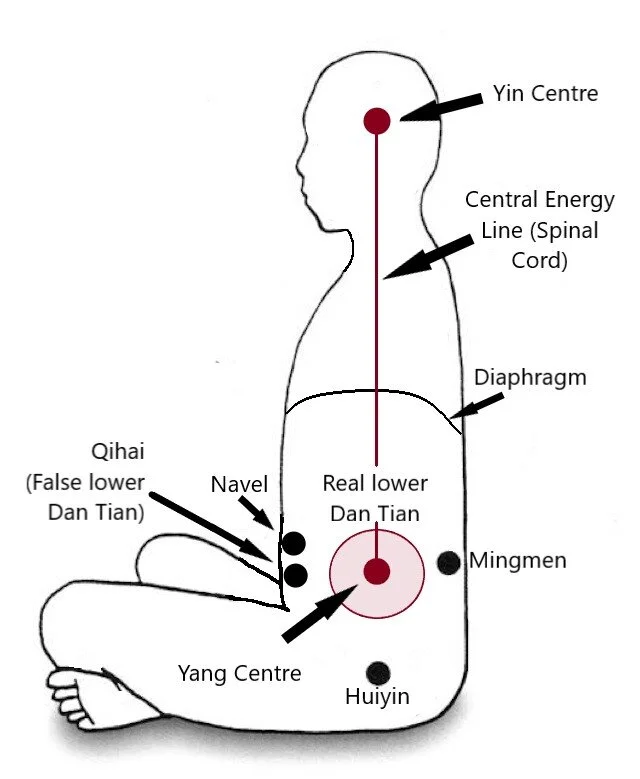
Many Daoist sources locate embryonic breathing in what is called the “sea of breath” or lower Dantian, typically described as lying a few inches below the navel. Wikipedia preserves a classical quotation stating:
“The sea of breath lies three inches below the navel… also called the lower dantian.”
Contemporary Daoist lineages, such as those represented by Water Dragon Arts, strongly emphasize the real lower Dantian as the center where qi is stored, condensed, and circulated during Taixi practice.
It is important to say “many lineages”, not “all traditions.” Daoism has never been monolithic.
Is Taixi Breath Retention?
This is where modern misunderstandings often arise.
Historically, some Taixi methods clearly include breath retention (biqi), as documented in Daoist sources. However, other approaches emphasize continuous but subtle breathing, visualization, or internal circulation without intentional breath holding.
Water Dragon Arts explicitly warns practitioners not to force apnea and stresses progressive refinement rather than the suppression of breathing.
A fact-accurate formulation is therefore:
Embryonic breathing may involve breath retention in some traditions, but it is not defined solely or universally by apnea.
Subjective Experience: “It Feels Like Breathing Stops”
Across multiple sources, practitioners report that during embryonic breathing:
-
physical respiration becomes extremely subtle
-
breathing may feel as if it has stopped
-
vitality and clarity remain present
Bonnie Bainbridge Cohen describes this somatically, noting that embryonic breathing can “feel like we are not breathing” and that respiration shifts from air movement to fluid and cellular perception.
Water Dragon Arts similarly notes that physical breathing may become imperceptible at times, without strain or distress.
Crucially, these descriptions refer to experience, not measurable cessation of respiration.
Somatic and Experiential Interpretations
Bonnie Bainbridge Cohen’s contribution is especially valuable because it demystifies Taixi without dismissing it. She frames embryonic breathing as a state in which the organism is “being breathed,” emphasizing:
-
yielding rather than control
-
sensing through fluids and tissues
-
non-mechanical respiration
Her work does not claim Daoist lineage but resonates strongly with Daoist descriptions of non-effortful regulation .
Internal Alchemy Perspective (Qualified)
In later Daoist internal alchemy texts, embryonic breathing is often associated with conserving vital essence, refining qi, and stabilizing spirit (shen). While the exact Jing-Qi-Shen triad is not spelled out in your original three sources, it is a well-established framework in Neidan literature (e.g., Cantong Qi, Zhong-Lü Chuandao Ji).
To remain precise, we can say:
In later internal alchemy traditions, Taixi is interpreted as a way of minimizing energetic leakage and supporting internal circulation.
This aligns with Water Dragon Arts’ emphasis on storing qi in the lower Dantian.
Modern Physiological Readings (Clearly Labeled)
Some modern practitioners interpret embryonic breathing through the lens of:
-
reduced metabolic demand
-
autonomic regulation
-
minimal respiratory movement
However, none of your core sources make explicit claims about parasympathetic dominance, heart coherence, or CO₂ tolerance. Those ideas belong to modern interpretive frameworks, not classical Daoist doctrine.
Therefore, such explanations should be labeled as contemporary hypotheses, not historical facts.
Who Should Practice Embryonic Breathing?
Classical Daoist texts already imply that Taixi is not a beginner’s method. Water Dragon Arts explicitly states that forcing advanced breathing without a foundation is unsafe.
A responsible summary is:
-
Taixi emerges after long-term cultivation
-
It should not be forced
-
It is unsuitable for people with unstable breathing, anxiety, or panic tendencies
Final Synthesis
Embryonic breathing is best understood as:
-
a historical Daoist concept, not a single technique
-
a range of practices and states, some involving breath retention, others not
-
a symbolic return to internal nourishment and minimal effort
-
an experience reported across Daoist, somatic, and meditative traditions
Taixi is not something to imitate.
It is something that appears when conditions are right.
[presto_player id=32487] |
Sources & References
Core Sources (Provided)
-
Wikipedia – Taixi (Embryonic Breathing)
https://en.wikipedia.org/wiki/Taixi_(embryonic_breathing) -
Bonnie Bainbridge Cohen – An Introduction to Embryonic Breathing
https://bonniebainbridgecohen.com/blogs/bonnie/an-introduction-to-embryonic-breathing-1 -
Water Dragon Arts – Embryonic Breathing
https://www.waterdragonarts.com/en/blog/embryonic-breathing
Additional Scholarly & Classical Context
-
Ge Hong – Baopuzi (4th century CE), early Daoist longevity practices
-
Fabrizio Pregadio – The Encyclopedia of Taoism
-
Livia Kohn – Daoist Meditation and Longevity Techniques