
Three-part breathing, known as Dirgha pranayama in Sanskrit, is one of the most fundamental and accessible breathing techniques in the yogic tradition, designed to activate the full capacity of the lungs while promoting deep relaxation and mental clarity.
This practice systematically fills the lungs from bottom to top, engaging the abdomen, diaphragm, and chest in a continuous wave-like motion that can be performed anywhere, whether standing, sitting, or lying down.
Understanding the Technique
Basic Practice Instructions
Dirgha pranayama unfolds in three distinct phases that flow seamlessly into one another. The first phase begins with an inhalation through the nose, allowing the belly to expand softly as air moves into the lower lungs. The second phase continues the inhalation as the breath fills the mid-chest and rib cage expands laterally. The final phase completes the inhalation as air fills the upper chest, and the collarbones subtly lift.
The exhalation reverses this pattern, releasing air first from the upper chest, then the mid-chest, and finally drawing the navel toward the spine to expel remaining air from the lungs. Each breath should feel like a gentle wave of motion with a thorough emptying of the lungs between cycles. Practitioners typically perform 10 to 12 rounds of this mindful breathing exercise to experience its calming effects.
Positioning and Modifications
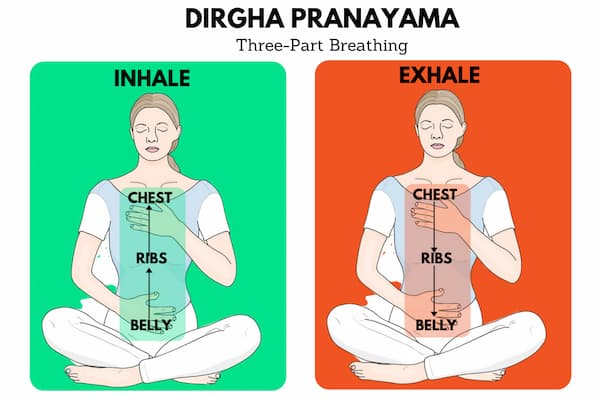
The practice can be adapted to various positions depending on comfort and circumstance. For beginners, lying down with knees bent provides the easiest way to observe the breath’s movement through all three sections. Placing one hand on the belly and another on the chest helps develop awareness of the breath’s progression through each region. Pregnant individuals in later stages should avoid lying flat on their back and may prefer seated or side-lying positions.
Physiological Mechanisms
Nervous System Activation
Three-part breathing creates a powerful shift in the autonomic nervous system by activating the parasympathetic “rest-and-digest” response. Deeper, fuller breaths signal safety to the body, triggering parasympathetic activity through the vagus nerve and reducing sympathetic “fight-or-flight” dominance. Research demonstrates that controlled breathing techniques enhance parasympathetic tone by stimulating the vagus nerve and modulating baroreceptor sensitivity.
Studies show that regular practice of pranayama breathing techniques increases parasympathetic activity, improving cardiovascular and respiratory function. One study examining yogic breathing patterns found that three-part breath components—abdominal, diaphragmatic, and chest breathing—performed in sequence create measurable impacts on physiological parameters. The practice promotes optimal diaphragm use, which research suggests improves lung compliance and ventilatory exchange.
Stress Reduction and Biomarkers
Scientific evidence confirms that diaphragmatic breathing effectively reduces physiological and psychological stress through multiple pathways. Clinical studies have documented improvements in stress biomarkers, including reduced respiratory rate, lower salivary cortisol levels, and decreased blood pressure, following diaphragmatic breathing interventions. These effects occur even with interventions ranging from a single 20-minute session to longer-term practice.
Health and Wellness Benefits
Mental and Emotional Effects
Practitioners report experiencing a clear mind, feelings of calmness and balance, and greater control over racing thoughts after several minutes of Dirgha pranayama. Research indicates that pranayama breathing exercises can significantly reduce anxiety and improve focus and emotional processing. The technique boosts oxygen delivery while lowering heart rate, which helps reduce stress and anxiety responses.
The practice creates a deeper connection to present-moment awareness and bodily needs, making it particularly valuable for centering the mind before yoga practice or transitioning into meditation. Yogic breathing exercises have been shown to produce beneficial changes in mood and emotional states.
Physical Benefits
Dirgha pranayama offers multiple physical advantages beyond stress reduction. The technique purges the lungs of residual carbon dioxide while maximizing oxygen intake. Experienced yoga teachers note that practitioners can take in and expel up to 7 times as much air as with shallow breathing. The practice focuses on the digestive system and promotes overall body relaxation. Some evidence suggests that yogic breathing practice may positively alter perceptual measures, with participants reporting that physical activities feel easier after regular practice.
Contraindications and Precautions
Medical Conditions Requiring Caution
While Dirgha pranayama is generally safe, certain medical conditions warrant careful consideration or medical consultation. Individuals with severe respiratory conditions such as asthma flare-ups or chronic obstructive pulmonary disease (COPD) should consult healthcare providers before practicing. Those with severe heart conditions or uncontrolled hypertension should approach the practice with caution and monitor their blood pressure and heart rate during sessions.
Recent abdominal surgery requires avoiding deep belly breathing until cleared by a surgeon, as increased abdominal pressure can hinder healing. Severe gastrointestinal issues, including hernias or acute acid reflux, may be exacerbated by the increased abdominal pressure from diaphragmatic breathing. Anyone experiencing acute chest or abdominal pain should avoid deep breathing exercises until the cause is identified and properly treated.
Practice Guidelines
Individuals prone to panic attacks or dizziness should proceed very cautiously and seek medical guidance before beginning practice. As with any breathing exercise, practitioners should monitor for adverse effects and discontinue if discomfort arises. The practice should always be performed with awareness and never forced, allowing the breath to flow naturally through all three regions without strain.
How to Practice Dirgha Pranayama
Choose a Supportive Position
Best options:
- Supine (recommended for beginners): lying on the back with knees bent
- Seated: upright spine with hip support, chest relaxed
Avoid forcing posture. Comfort and ease are essential.
Place:
- one hand on the belly
- one hand on the chest or side ribs
This encourages awareness, not control.
Step 1: Gentle Reset
Exhale through the nose until the breath feels complete.
No pushing. No abdominal force.
Step 2: Inhale in One Continuous Wave
Inhale slowly through the nose:
- Belly and lower ribs soften and expand
- Side ribs widen
- Upper chest lifts subtly near the collarbones
The inhale is one smooth motion, not three steps.
Step 3: Exhale in Reverse
Exhale smoothly through the nose:
- Upper chest releases
- Ribs draw inward
- Belly returns gently toward the spine
Let the breath empty itself.
Step 4: Rhythm and Volume
- Begin with 6–10 slow breaths
- Optional pacing:
- inhale ~4–5 seconds
- exhale ~5–6 seconds
Reduce volume if you feel lightheaded or tense. Smaller, calmer breaths are more effective.
Common Errors to Avoid
Dirgha Pranayama loses its benefit when over-effort appears.
Watch for:
- forcing the belly outward
- aggressive chest lifting
- inhaling too deeply
- tension in the jaw, neck, or shoulders
- treating the breath mechanically
A correct practice feels quiet, easy, and almost unremarkable.
Benefits You Can Responsibly Expect
Nervous System
- improved parasympathetic tone
- reduced stress reactivity
- smoother transitions into rest and sleep
Physical
- better rib-cage mobility
- reduced neck and shoulder tension
- more complete ventilation
Mental & Emotional
- calmer mental state
- improved focus
- greater interoceptive awareness
These benefits are supportive and cumulative, not instant or dramatic.
Contraindications and Practical Cautions
Dirgha Pranayama is generally gentle, but care is still required.
Use caution or seek guidance if you have:
- severe or acute asthma or COPD flare-ups
- uncontrolled hypertension or serious heart conditions
- recent abdominal surgery
- active hernias or severe GERD
- acute chest or abdominal pain
Individuals prone to panic or dizziness should:
- Keep breaths shallow and slow
- avoid breath retention
- Stop immediately if discomfort arises
The breath should never be forced.
When to Practice
Dirgha Pranayama fits easily into daily life:
- morning, to establish a calm baseline
- evening, to down-regulate before sleep
- before meditation or yoga
- during moments of emotional overload
Consistency matters more than duration. Five calm minutes is enough.
The Deeper Lesson
Dirgha Pranayama teaches a subtle but essential skill:
Stop interfering with the breath.
As the body relearns efficient breathing, patterns reorganize naturally, slower, quieter, fuller, without conscious effort.
That is the true sign of integration.
Final Perspective
If breathwork were a structure, Dirgha Pranayama would be the foundation.
Not optional. Not glamorous. But essential.
Once this foundation is stable, every other pranayama or breathwork method becomes safer and more effective.
Sources & References
Classical Yoga & Educational Sources
- Kripalu Center for Yoga & Health – How to Do Three-Part Breath (Dirgha Pranayama)
https://kripalu.org/resources/how-do-three-part-breath-dirgha-pranayama - The BioMedical Institute of Yoga & Meditation – Dirgha Prānāyāma
https://biyome.com.au/pranayama-manual/dirgha-pranayama/ - Everyday Yoga – How to Practice Three-Part Breath in Yoga
https://www.everydayyoga.com/blogs/guides/how-to-practice-three-part-breath-in-yoga - Gurukul Yogashala – Dirgha Pranayama: Meaning, Benefits & Technique
https://gurukulyogashala.com/blog/dirgha-pranayama/ - Yanva Yoga – What Is Dirgha Pranayama? Steps & Benefits
https://yanvayoga.com/what-is-dirgha-pranayama-three-part-breathing-steps-benefits/ - Prana Sutra – Pranayama Breathing Exercises for Anxiety
https://www.prana-sutra.com/pranayama-breathing-exercises-for-anxiety-stress
Scientific & Medical Research
- Scientific Reports (Nature) – Immediate Impact of Yogic Breathing on Cerebrospinal Fluid Dynamics
https://www.nature.com/articles/s41598-022-15034-8 - PubMed – Effectiveness of Diaphragmatic Breathing for Reducing Physiological and Psychological Stress
https://pubmed.ncbi.nlm.nih.gov/31436595/ - PubMed Central (PMC) – Effects of Three Weeks of Yogic Breathing Practice on Ventilation
https://pmc.ncbi.nlm.nih.gov/articles/PMC7039472/ - PubMed Central (PMC) – Assessment of the Effects of Pranayama on the Parasympathetic Nervous System
https://pmc.ncbi.nlm.nih.gov/articles/PMC3681046/ - Healthcare Bulletin – Five Weeks to Better Autonomic Function: Insights from Yogic Breathing
https://healthcare-bulletin.co.uk/article/five-weeks-to-better-autonomic-function-insights-from-yogic-breathing-3418/ - YogaUOnline – Relaxation, Yogic Breathing, and the Vagus Nerve
https://yogauonline.com/yoga-health-benefits/yoga-for-stress-relief/relaxation-yogic-breathing-and-the-vagus-nerve-its-all-about-the-exhalation/